







Skin Longevity: A New Direction for Retinoid Formulation
For decades, skincare framed aging as something to erase. Today the conversation is shifting toward skin longevity: keeping skin structurally sound, resilient and functional across decades rather than chasing a quick fix. Most of the visible aging on the face is photoaging, the cumulative result of ultraviolet exposure that shows up as fine lines, wrinkles, uneven pigmentation and a weaker barrier. Among topical actives, retinoids have the deepest body of evidence for addressing these changes at the cellular level, which helps explain why the retinoid market is projected to reach roughly $2.5 billion by 2032. For brands, contract manufacturers and the teams that source their raw materials, the question is no longer whether a longevity formula needs a retinoid, but which retinoid will deliver results consumers can sustain for years. So, the brief shifts from maximum strength to the best balance of efficacy, tolerability, stability, and regulatory freedom.
How Retinoids Support Skin Renewal and Collagen
Retinoids work by binding to retinoic acid receptors (RAR-α, RAR-β and RAR-γ) in skin cells and switching on retinoic acid–responsive genes. The downstream effects line up closely with the biology of longevity: more orderly epidermal renewal, increased collagen production, with retinol shown in controlled studies to improve naturally aged skin, and reduced activity of the collagen-degrading matrix metalloproteinases that build up as skin ages. The catch has always been tolerability. Conventional retinoids are known for redness, stinging, flaking and barrier disruption; one clinical assessment recorded an 88% increase in transepidermal water loss with retinol. Longevity is a long game, and an active that consumers abandon after a few irritated weeks protects no one’s collagen. That is why receptor selectivity and smarter delivery have become the defining variables in modern retinoid design.
The Four Generations of Retinoids
Retinoids are classified into four generations, each more receptor-selective than the last. First-generation retinoids, including retinol, retinaldehyde and tretinoin, are natural vitamin A derivatives that bind all three RARs; they are well studied but oxidatively unstable, prone to irritation and increasingly subject to concentration caps, including in the EU. Second-generation molecules such as etretinate and acitretin are oral drugs for severe conditions like psoriasis and play no role in topical cosmetics. The third generation, led by adapalene and tazarotene, was built synthetically rather than on the fragile vitamin A skeleton; adapalene favors RAR-β and RAR-γ, is photostable and is known for lower irritation than older retinoids. The fourth generation, represented by trifarotene, goes further still, selectively targeting RAR-γ, the receptor that makes up roughly 90% of the RARs in the epidermis.
Prodrug Retinoids: Delivery and Clinical Evidence
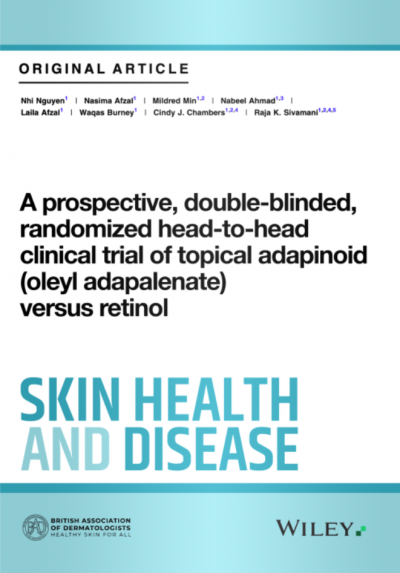
For most of their history, third- and fourth-generation retinoids were confined to drug products. Prodrug chemistry is what finally brings these advanced retinoids into cosmetic formulas. Attaching a fatty ester to the active molecule creates an inactive, oil-soluble precursor; once applied, esterases concentrated in the epidermis gradually cleave the ester and release the active retinoid within the skin. Oleyl adapalenate, for instance, has an octanol–water partition coefficient of 10.47 versus 6.06 for adapalene, which may help it move through the stratum corneum before converting. The approach now has clinical backing. In a 12-week, double-blind, randomized head-to-head trial published in Skin Health and Disease, 0.5% oleyl adapalenate (Adapinoid®) reduced wrinkle severity by 9.45%, more than double the 4.11% seen with 0.5% retinol (p = 0.001 between groups). It also reduced facial redness by 13.4% where retinol produced no significant change, matched retinol on pigmentation, and drew no reports of moderate or severe irritation at any visit. The study was funded by Actera, but the sponsor had no role in its design, analysis or publication, and Dermatology Times covered the results. In a separate 12-week Actera study led by dermatologist Raja Sivamani, MD, trifarotenyl caprylate (Trifarotol®) matched prescription tretinoin on wrinkle reduction with no statistically significant difference, while posting roughly twice the gain in skin elasticity at week 12 (22.2% vs. 11.7%) and fewer reported adverse events (6% vs. 21%).
How Skincare Brands Are Adopting New-Generation Retinoids
Brands have noticed. Lili Reinhart’s Personal Day built its Just Like New Adapinoid Repair Serum around 0.5% Adapinoid® (oleyl adapalenate); Reinhart, who describes her skin as highly reactive, told Women’s Health, “So I started using this adapinoid serum, and it’s incredibly gentle.” Martha Stewart’s Elm Biosciences, co-founded with dermatologist Dhaval Bhanusali, MD, chose trifarotenyl caprylate (Trifarotol®) for its A3O Elemental Night Cream after Stewart found traditional retinoids too drying and irritating. “We’re bringing the fourth generation retinoid to the skincare world,” Dr. Bhanusali told Women’s Health. Skinfix’s acne+ Adapinoid Gel, sold at Sephora, is an Allure Best of Beauty award winner; Colgate-Palmolive’s PCA SKIN incorporated oleyl adapalenate into a professional acne peel evaluated in the Journal of Cosmetic Dermatology; and Paula’s Choice rates oleyl adapalenate “Best” in its Ingredient Dictionary. New-generation retinoids have become the go-to actives for big-name brands that need visible results without the irritation that fuels returns and negative reviews.
Practical Formulation Considerations for Skin Longevity
The practical advantages matter as much as the clinical ones. Adapinoid® (oleyl adapalenate) and Trifarotol® (trifarotenyl caprylate) are oil-soluble, oxidatively stable powders added to the oil phase, with no solvents, nitrogen blanketing, airless packaging or antioxidant systems needed to protect potency, and Adapinoid® allows clean white emulsions instead of the yellow cast typical of vitamin A actives. Use levels are efficient: 0.16–0.5% for Adapinoid®, which was clinically tested at 0.5%, and just 100 ppm for Trifarotol®. Adapinoid® is protected by U.S. Patent No. 12,133,907 and Trifarotol® is patent pending, and starter formulations such as the Refiner and Renewing Lotion shorten development timelines. For brands that still want a classic vitamin A story, Hydroxysomes® Retinol and Hydroxysomes® Retinaldehyde offer calcium-encapsulated, stabilized versions of the first-generation favorites. As the industry moves from fighting age to sustaining skin over a lifetime, the retinoids people can tolerate every night are the ones that will define skin longevity. Explore Actera’s prodrug portfolio or request a sample to put them to work in your next launch.
Frequently Asked Questions About Retinoids and Skin Longevity
1. How do retinoids support skin longevity?
Retinoid signaling supports orderly epidermal renewal, collagen production and reduced activity of collagen-degrading matrix metalloproteinases. These effects help address visible signs of photoaging, including fine lines, wrinkles and uneven pigmentation. In the article, skin longevity means maintaining skin structure, resilience and function over time.
2. Why does retinoid tolerability matter for long-term skincare?
Redness, stinging, flaking and barrier disruption can discourage consistent use. Because a skin-longevity approach depends on sustained use, formulators need to balance efficacy with tolerability and stability. Receptor selectivity and delivery approaches are important considerations when choosing a retinoid for a long-term skincare formula.
3. What are the four generations of retinoids?
First-generation retinoids include retinol, retinaldehyde and tretinoin. Second-generation examples include etretinate and acitretin, which are oral medicines rather than topical cosmetic ingredients. Third-generation examples include adapalene and tazarotene. The fourth generation includes trifarotene, which selectively targets RAR-γ. The article distinguishes these parent retinoids from ester-based precursors used in cosmetic formulations.
4. How do prodrug retinoids work in the skin?
The prodrug approach described in the article attaches a fatty ester to a retinoid to create an oil-soluble precursor. Skin esterases cleave the ester to release the active retinoid within the skin. The article discusses oleyl adapalenate and trifarotenyl caprylate as examples of this approach.
5. What clinical evidence does the article report for oleyl adapalenate versus retinol?
The article cites a 12-week, double-blind, randomized trial comparing 0.5% oleyl adapalenate with 0.5% retinol. It reports wrinkle-severity reductions of 9.45% and 4.11%, respectively, and a 13.4% reduction in facial redness with oleyl adapalenate. The oleyl adapalenate group reported no moderate or severe irritation at any visit. These findings describe the tested formulations and study conditions. The article discloses Actera funding and states that the sponsor had no role in study design, analysis or publication.